Certificate lifecycle management
Central PKI visibility, validity tracking and renewal automation for supported systems.

Digital trust, with CyberLion
Digital certificates, lifecycle management, identities and DNS, with expert guidance tailored to your organization.
CERTIFICATE MANAGEMENT · TLM
Discover your certificates, track their validity and manage renewals in one place. Less manual work. More control.
Capabilities depend on licensing and integrations. Internal discovery may require a Sensor; server management may require an Agent.

DIGICERT · TLS/SSL
TLS/SSL certificates encrypt communications and authenticate the server. We help match identity validation and domain coverage to your needs.
DIGICERT ONE
From a website certificate to a device identity — solutions for your infrastructure, developers and business workflows.
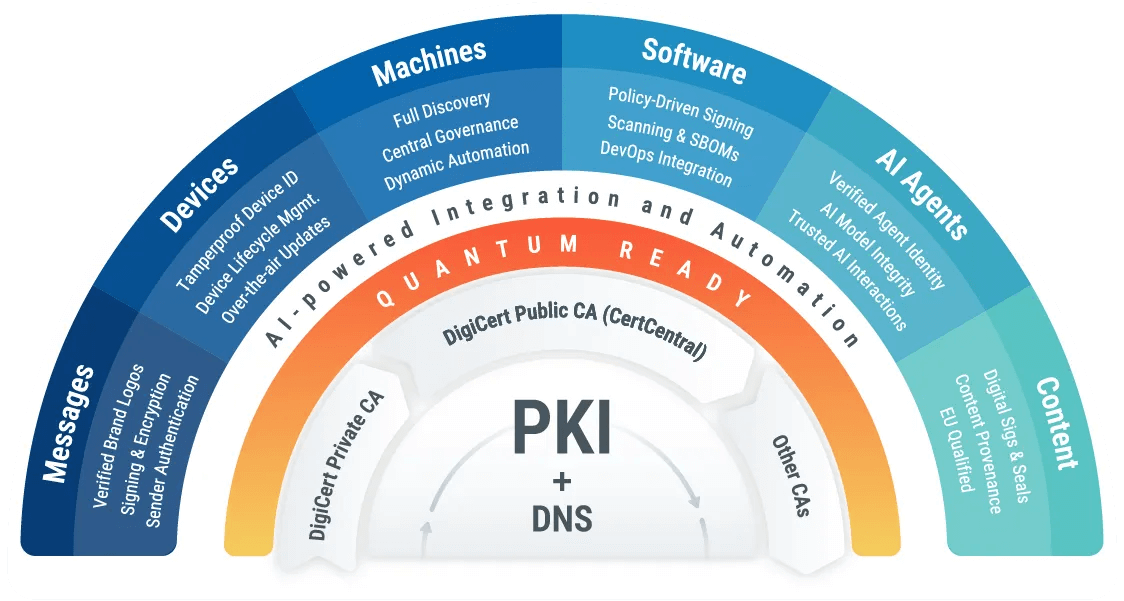
Central PKI visibility, validity tracking and renewal automation for supported systems.
Verify publisher identity and detect changes after signing as part of your software delivery process.
Manage digital identities for IoT devices throughout their lifecycle, from manufacture to retirement.
Verify signer identity and detect document changes, integrated with business workflows.
Adapt to complex environments, multiple teams and enterprise identity and digital trust requirements.
TRUST AT EVERY TOUCHPOINT
Code signing to verify publisher identity and detect changes to a signed file.
S/MIME certificates for email signing and encryption, according to your configuration.
Signatures to verify signer identity and detect changes after signing.
ANSWERS BEFORE YOU CHOOSE
The key differences, with practical explanations to help you make the right choice.
TLS/SSL: Encrypt communications between the browser and server, and authenticate the server.
S/MIME: Sign email messages and, depending on configuration and available certificates, encrypt them.
Code Signing: Verify the software publisher’s identity and detect changes to a file after signing.
Document signing: Verify the signer’s identity and detect changes to a document after signing.
A certificate does not guarantee that a website or software is free from vulnerabilities or malicious content.
DV: Validates control of the domain.
OV: Validates domain control and verifies the organization’s identity.
EV: Verifies the organization’s identity under more extensive requirements.
The difference is the depth of identity validation, not encryption strength. EV does not guarantee a green address bar or a company name displayed in the browser.
FQDN: A specific, fully qualified domain name, such as shop.company.com.
SAN: Additional names listed in the same certificate.
Wildcard: Subdomains at one level, such as *.company.com.
In this example, the wildcard covers shop.company.com and mail.company.com. It does not cover a.shop.company.com, which is one level deeper. The base domain company.com must also be explicitly included in the certificate.
Covering a name such as mail.company.com in a TLS certificate does not sign or encrypt email messages; that requires S/MIME.
These are different product packages. Choose the package that fits your needs, then the domain names and coverage. Included services and add-ons vary by product and offer, so check the details of your specific package.
Public: Issued from a trust chain recognized by supported browsers and systems, subject to public issuance requirements.
Private or internal: Used within an organization; trust in the issuing authority must be configured on the relevant computers and systems.
“Internal” does not simply mean that a website requires a login. The difference is who trusts the certificate and how that trust is configured.
A Certificate Signing Request (CSR) contains a public key and the required certificate details. Your IT team, server administrator or hosting provider creates it in the environment where the certificate will be used. The private key stays with you and is not sent with the CSR.
The subscription period and the validity of an individual certificate may differ. Make sure certificates are renewed and installed before they expire. Alerts support tracking; automation requires the appropriate configuration and integrations.
A Verified Mark Certificate (VMC) verifies a logo for BIMI display in supporting email services, subject to their requirements. It does not replace S/MIME certificates for signing or encrypting email.
Before ordering, prepare the use case, domain names, organization details and an installation contact.
DIGICERT ULTRADNS
Managed enterprise DNS, with a focus on availability, performance and control.



CYBERLION · START WITH YOUR NEEDS
We will guide you to the right certificate or certificate management approach for your organization.