
Privileged Access Management (PAM) is no longer just about vaulting admin passwords. Modern environments — cloud, DevOps, SaaS, and machine identities — have fundamentally changed how privileged access behaves.
Many organizations still rely on legacy models: central IT control, static credentials, and periodic access reviews. But today’s attack surface is dynamic, distributed, and increasingly automated.
The Problem with Traditional PAM
Old-school PAM focuses mainly on:
- Human administrators
- Password vaults
- MFA enforcement
- Scheduled reviews
That model doesn’t account for API keys, service accounts, ephemeral workloads, or real-time session risk.
A Modern PAM Strategy in 8 Steps
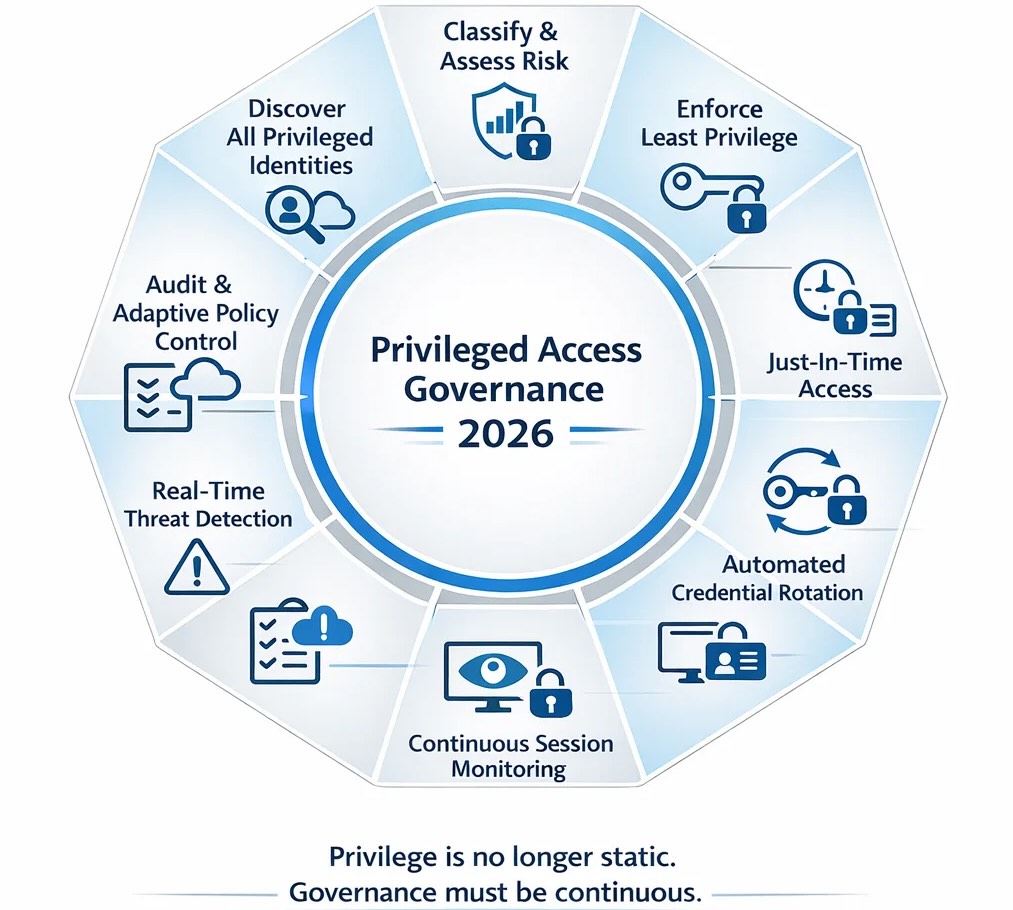
A future-ready approach requires a broader framework. The 8 essential steps include:
- Discover all privileged identities (human and machine)
- Classify and assess risk exposure
- Enforce least privilege access
- Implement Just-in-Time (JIT) access
- Secure and rotate credentials automatically
- Monitor and record privileged sessions continuously
- Detect anomalies in real time
- Audit and adapt policies across hybrid and cloud environments
This shifts PAM from a reactive control to a proactive governance model.
Why It Matters
Credential abuse remains one of the most common attack vectors. Without continuous visibility and policy enforcement across identities, organizations risk lateral movement, data exposure, and compliance gaps.
PAM in 2026 isn’t just about protecting passwords.
It’s about governing privilege everywhere it exists.
How SEGURA Enables Modern PAM
SEGURA’s PAM solution is built for the 2026 reality. It goes beyond password vaulting to provide full privileged identity governance across hybrid, cloud, and DevOps environments. SEGURA helps organizations discover and secure all privileged accounts — human and machine — enforce least privilege with Just-In-Time access, continuously monitor sessions, and maintain real-time visibility and auditability. The result: reduced attack surface, stronger compliance posture, and proactive control over modern privilege risk.